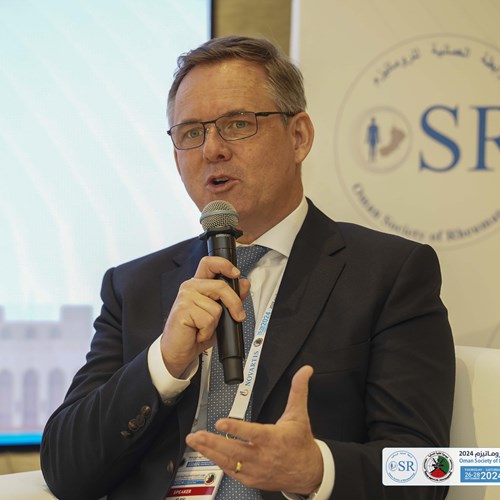


Philip J. Mease is Director of Rheumatology Research at Providence Swedish Medical Center and Clinical Professor at the University of Washington School of Medicine in Seattle, WA, USA. His clinical practice is based at Seattle Rheumatology Associates, a Providence affiliate. Dr Mease earned his undergraduate and medical degrees at Stanford University. He then completed residency in internal medicine and fellowship in rheumatology at the University of Washington School of Medicine.
Dr Mease’s research interests include psoriatic arthritis (PsA), spondyloarthritis (SpA), rheumatoid arthritis (RA), systemic lupus erythematosus (SLE) and fibromyalgia (FM). His research focuses on disease state, outcome measure development, and determining the efficacy and safety of emerging therapies for these conditions. His seminal 2000 Lancet paper established the efficacy of anti-tumour necrosis factor (TNF) therapy in PsA. He currently leads studies utilizing cell therapy, such as CAR-T cell therapy, to achieve deep remission in lupus, scleroderma, RA, and myositis. He has authored over 750 journal articles, several thousand abstracts, as well as being editor of and chapter contributor in textbooks on PsA and AxSpA.
Expertscape ranks Dr Mease as the most published expert in PsA and psoriasis worldwide and the 12th most published expert in axial spondyloathritis (AxSpA) in the past decade. He is ranked in the top 40 most cited University of Washington faculty. Dr Mease is a prolific international speaker at academic congresses, grand rounds, and virtual educational activities for rheumatologists, dermatologists, and gastroenterologists, and is considered an international key opinion leader, researcher, educator, and clinician regarding SpA, including PsA, and the complexities of pain in rheumatic disease. He is a reviewer for multiple journals including New England Journal of Medicine, Lancet, Arthritis & Rheumatology, Arthritis Care & Research, Annals of the Rheumatic Diseases, The Journal of Rheumatology, and Seminars in Arthritis and Rheumatism. In 2019 the National Psoriasis Foundation awarded him a lifetime achievement award for his work in advancing the field of PsA. In 2022, Dr Mease received the Legacy award from the Arthritis Foundation. In 2023, the Verna Wright Prize for contribution to the field of psoriatic arthritis, and the Kahuna award from Rheumatology Winter Clinical Symposium (RWCS) for excellence in education. He was the Gilke Visiting Professor at the Mayo Clinic in 2022. In 2026, he was inducted as a Fellow of the Royal College of Physicians (UK). Dr Mease is a Master of the American College of Rheumatology (ACR) and has received its Medical Communicator of the Year Award for teaching.
Dr Mease is Past President and Founding Organizer of the Group for Research and Assessment of Psoriasis and Psoriatic Arthritis (GRAPPA) and is current treasurer and Education committee chair of this > 1000 international rheumatology and dermatology society. He is a member of the Assessment of
Spondyloarthritis international Society (ASAS), member and on the Education committee the Spondyloarthritis Research and Treatment Network (SPARTAN), and Past President of the Northwest Rheumatism Society. He has also been active in the Outcome Measures in Rheumatology (OMERACT) research organization as Co-Chair of the PsA, AxSpA, CNO/SAPHO, and chronic pain working groups and as a member of the OMERACT steering committee. He has served in an educational and advisory role for the US Food and Drug Administration (FDA) and is a member of the steering committee of the arthritis section of the International Consortium for Health Outcomes Measurement (ICHOM).
Dr. Mease conducts disease state research in registries such as the CorEvitas (formerly Corrona) US disease registry, for which he is Director of the PsA–SpA arm. He also serves as a key consultant to a Providence affiliate, Institute for Systems Biology (ISB), conducting artificial intelligence (AI) research studies in system-wide (Providence) autoimmune disease populations. He conducts translational research through ISB and the GRAPPA Collaborative Research Network.